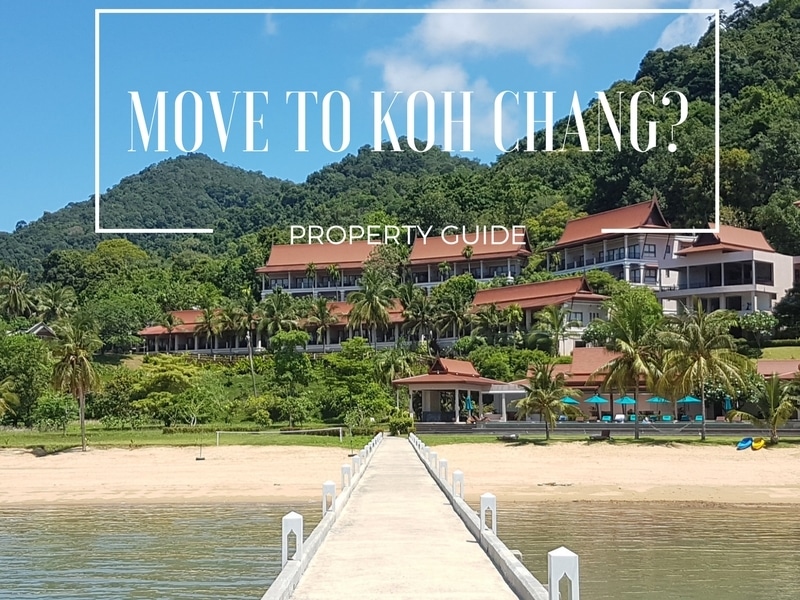
Guide for buying land, a house or a business on Koh Chang.
Once tourism has taken hold then it’s only natural that more people will want to move to the island. Some to work and run a business, others to buy a holiday home or retire. Either way, more people will want to buy property.
Islands in the south of Thailand have already experienced their significant real estate boom, Phuket in the early 90s and Samui on the early 2000s for example. Here on Koh Chang that hasn’t yet happened. There was a mini-boom around 2005 – 2007, with the initial launches of Siam Royal View and Tranquility Bay Residence developments. Then came the 2008 financial crisis. And almost 20 years on these are still the only large scale developments on the island and both are far from completed.
As the number of resorts has increased, the number of residential developments for sale hasn’t. There have been several attempts at other housing and condominium projects but these were either badly timed, badly managed or poorly conceived in locations that would struggle to get buyers even in the best of times.
Although there have been a few exceptions. Small pool villa projects in convenient, west coast locations have done pretty well. And Pattaya based ESS Developments are currently ( mid 2026) constructions a mid-price, low rise condo block in Klong Prao village.
However, the number of bungalows for long stay (monthly or yearly) rentals definitely has shot up. It would seem that Koh Chang is overdue a property boom as more and more people are looking to stay here longterm. But a couple of factors have put the brakes on this:
– Lack of foreigner friendly infrastructure. Koh Chang has the basics. But it’s still not a major destination for tourists. The island doesn’t have the shopping, entertainment, attractions, amenities for families that attract a large number of potential buyers.
– The lack of available land in good locations. As the hillsides are virtually all within the National Park, the only way you’ll get a sea view on Koh Chang is if you are right on the beach. Add to that a relatively small amount of land having good title deeds. And even less of that being on the west coast of the island within easy reach of the beaches. Add to that local families not wanting to sell land, only rent it and you can see that it’s a very different situation to Samui or Phuket where there is ample land available for development inland a few minutes drive from the busy beach areas. You can buy a 2 bedroom house built on land with a good title deed, within walking distance to a beach, shops and restaurants on Samui for 3 Million Baht. You can’t do that on Koh Chang.
So, for anyone interested in buying a property or taking over a resort or bar etc on the island, on this page you will find some general information about buying property in Thailand, followed by Koh Chang specifics.

Can Foreigners own a house and land in Thailand?
First of all if you want to get the definitive guide to doing things legally in Thailand then you should read Samuiforsale.com. You’ll get much better advice there on pretty much all aspects of Thai law, for free, than you will from many lawyers.
Freehold ownership
If you want to own something Freehold with your name on the title deed then you are limited to a condominium. 49% of the floor area in a block fall into the Foreign Ownership quota. The remaining 51% must be sold Leasehold or held in a Thai name. You’ll often have to pay a premium to get one of the Freehold units, as these are usually easier to sell in the future.
One caveat is that the money to buy a Freehold condo must be brought in from outside the country specifically for the purpose. You’ll need to make sure you obtain an F.E.T form from your Thai bank. The Land Office will want to see this and you’ll need it if you ever want to sell and repatriate your funds.
Under Thai law, any person can register any type of building in their own name. So the good news is that foreigners can own their houses. However, the ownership of land is restricted. It is virtually impossible for a foreigner to own land freehold. Therefore, some buyers will opt to own their house, but lease the land it is built on.
Leasehold
Foreign buyers can have a 30 year lease on a plot of land assuming a) that it has a Chanote or Nor Sor Sam Kor title deed and b) the landlord goes a long with it and agrees to register the lease at a government Land Office.
Leases are often advertised as having one or two renewal periods. Different law firms have different opinions as to the legality of allowing only one or a maximum of two further periods of 30 years each, making a total of 60 or 90 years. But the bottom line is that these aren’t guaranteed by law and can’t be registered in advance.
So if you’re buying on a development where everyone has the same leases, then you might have problems. This article about a notorious Samui developer and an entire development who lost their holiday and retirement homes when the leasehold contracts weren’t renewed is worth reading.
In March 2025 the Supreme Court of Thailand ruled on a long running case in Phuket based on a lessee signing two 30 year extensions in advance. Bottom line is that it there’s no way to enforce the renewal of a 30 year lease with the landlord. Any renewal is dependent on the goodwill of the owner of the land.
A good leasehold agreement should clearly explain whether you can sublet the property or transfer the remaining lease to someone else, and whether the landlord’s consent is required. Don’t assume that paying for 30 years gives you the freedom to sell or rent it out whenever you like. Get those rights written into the agreement before signing.
Also check what happens if you die before the lease expires. Your heirs don’t automatically get the same rights as someone inheriting a freehold property. Whether they can continue using the property depends on the lease terms and the legal nature of the arrangement. Thai court decisions have recognised leases continuing after the tenant’s death in certain circumstances, so it’s equally misleading to say that every lease automatically ends when the tenant dies. Have your lawyer check the succession wording, any cooperation required from the landlord and the Land Office procedures your heirs would need to follow.
You must get the lease registered. If this is not done the enforceable period of any lease is only 3 years. This is regardless of what is written on the contract and regardless of what anyone who may appear to be your new best friend or a guy in a bar tells you.
Remember this especially if you are planning on buying a business or resort on Koh Chang which will be built on rented land. The only guarantee is for the first 3 years. After that, you just have to hope the landlord keeps to their side of the deal and renews the contract as agreed. Usually they will, as landlords are happy to have tenants who pay on time and don’t cause any problems. But if they decide they don’t want to renew the lease for whatever reason then you’re screwed. You can try to fight their decision in court but you’d eventually lose.
For a foreign buyer looking for a house or villa, a registered land lease is one legal option. However, there is another less well-known option – Sap Ing Sith – which is worth considering where the property qualifies, particularly if transfer and inheritance rights are important.
Sap Ing Sith
There’s another legal option worth knowing about if you’re looking for a house or land in Thailand: Sap Ing Sith, sometimes written as Sapingsith or Sap-Ing-Sith. The Thai name is ทรัพย์อิงสิทธิ.
Introduced in 2019, this allows foreigners to hold a registered right to use a property for up to 30 years. The land still belongs to its owner. What you acquire is a separate property right which can be transferred, inherited or mortgaged. So, despite how an enthusiastic agent might describe it, this isn’t foreign freehold land ownership.
How is it different from a normal lease?
The main advantages are what happens if you want to sell, leave the property to someone or borrow against your interest in it.
A normal residential lease is primarily a contractual arrangement with the landlord. Sap Ing Sith creates a separately registered right, with transfer and inheritance provided for by law. You can transfer that right to another person without needing the landowner’s permission for each transfer, although the transaction must be registered at the Land Office. The right can also pass to your heirs or be used as mortgage security. ( Although being legally mortgageable doesn’t, of course, mean a bank will agree to lend you money.)
However, selling or inheriting it doesn’t restart the clock. If you sell after ten years of a 30-year term, the buyer gets the remaining 20 years. You are selling the remaining right to use the property, rather than the land itself.
What are the catches?
The 30-year limit still applies. There’s no automatic renewal right. Any fresh arrangement at the end would require the owner’s agreement and a new registration. Value the deal on the years you actually receive, rather than promises about what might happen three decades later.
For land, you need a Chanote title. Sap Ing Sith can also cover land with buildings and condominium units, but it isn’t available for every type of land document. Nor Sor Sam Kor, which can support a registered lease, isn’t sufficient for this arrangement. That’s particularly relevant on Koh Chang, where checking the title should come before getting excited about the house or view.
It must cover the whole titled property. You can’t register it over an informal corner of someone’s larger Chanote plot. If you’re being offered a small house plot within a larger holding, ask whether subdivision must be completed before registration.
You need to agree what happens to buildings when it ends. Buildings you construct, extend or modify normally become the landowner’s property when the right expires, unless otherwise agreed. That’s something to sort out before paying for a villa, pool or substantial renovation.
The landowner also retains the ability to sell or mortgage their ownership. Your lawyer should check existing mortgages and other registered rights, any required consents, and how these affect your position. Sap Ing Sith doesn’t remove the need to investigate the property properly.
Is it worth considering on Koh Chang?
Yes, particularly if being able to easily transfer your interest or leave it to your heirs is important. It’s a legal option that doesn’t require setting up a company simply to hold your home.
But it won’t fix a poor land title or give permission to build where construction isn’t allowed. Before handing over money, have a lawyer check the title, access, permitted use, registration arrangements and what happens at the end of the term.
Think of it as buying a defined period of use with useful rights to sell or pass on the remaining years.
Thai Company Ownership
First lets look at the pre-2025 situation.
Freehold ownership is king for many potential buyers. In the past it was possible to have a lawyer set up a Thai registered company that is controlled by the foreign buyer. The company could then own land Freehold. This was a common option for buyers across Thailand. Unfortunately, whilst it was promoted by many developers and lawyers – it wasn’t strictly legal.
There were a couple of reasons for this. Firstly, setting up a company specifically to hold land as a way of bypassing foreign ownership laws is dodgy. Secondly, as most foreign buyers didn’t know any Thais they could trust the friendly lawyer said “No problem, I’ll handle that” and used a nominee shareholder. They were usually a member of staff or friend of a friend who got a couple of thousand Baht for signing some paperwork – which in legal terms is also dodgy.
Two shareholders are needed in order to set up a company, at least one must be Thai. The Thai shareholder has to hold at least 51% of the shares. ( Until 2023, the requirement was for three shareholders. )
The lawyer always set up the company so the foreign shareholders had the voting shares and therefore controlled the company and it’s assets and bank account. Even if you didn’t use your company for any business you still had to submit accounts and an annual audit. Just like a legitimate company would do.
When it came to selling a property the good news was that it was easy to sell the property and company together. A lawyer just had to simply change the name of the foreign shareholder in the company. There was no need to go via the land office and have to pay transfer fees and taxes on the sale. So win/win for buyer and seller, but the state lost out of tax revenue.
Over the years there were occasional rumors of impending crackdowns, usually following some new story about small time foreign developers ripping off fellow countrymen in Pattaya or Phuket. But that didn’t happen . . . until it did in 2025.
Post 2025
As of 2026, all the law firms that were previously happy to set up companies for foreign buyers have conveniently forgotten they were doing that.
A crackdown on foreign ownership of property through company ownership started in 2025 and has continued, and gained pace, throughout 2026. This doesn’t affect anyone who owns property via a legitimate company with genuine shareholders – only those who make the the majority of buyers and use a company and nominee shareholders as a way to bypass the ownership law. The latter make the the vast majority of foreign house / villa buyers.
In 2025 it was still possible for a lawyer to remove and replace ‘problem’ shareholders and get some creative ideas for funneling money through the company to make it appear to be legit. But that avenue is now firmly shut.
From 1 March 2026 onwards any shareholder changes to a Thai / foreign owned company trigger an investigation into the source of funds for the Thai shareholders and adds a requirement for the Managing Director of the company to confirm in writing that all shareholders have invested genuinely and none are nominees.
This leads to serious problems for anyone with a dodgy company who is now trying to sell their home. They need to get it out of a company ownership structure but to do that now is extremely difficult. Any Thai shareholders have to provide bank statements and proof of funds of their investment in the company and also face huge fines and potential jail terms for acting as nominees. ( More info on this here. )
The only viable option now for many expat homeowners is to sit it out if possible and wait and see what happens in the coming year or two when the heat has died down. Then obtain independent legal advice on your existing structure and see what is possible – preferably without bending the law too much.
Usufruct
A usufruct is a legal right that lets you use and benefit from someone else’s property without owning it. The Thai name is Sitthi Kep Kin. You can live there and, subject to the agreement and applicable laws, rent it out and receive the income.
For foreigners, it’s another way to secure use of land without owning the land itself. It can be granted for a fixed period of up to 30 years or for your lifetime. To establish a right that protects you against subsequent buyers, it must be registered at the Land Office. A private agreement alone doesn’t give you the same protection.
Why use a usufruct?
It can be useful if your main aim is to have somewhere to live for the rest of your life. For example, where a Thai partner owns the land and the foreign partner wants a registered right to continue living in the home.
The owner can still sell or transfer the property. However, the new owner takes it subject to your registered usufruct. Selling the land doesn’t, by itself, cancel your right to use it. The original owner’s death doesn’t cancel it either.
There is one important catch: the usufruct ends when you die. That applies even if you registered it for 30 years and there are still years remaining. Your heirs don’t inherit the usufruct, and you can’t sell the right itself in the same way as a Sap Ing Sith interest. Allowing someone else to exercise your rights, where permitted, doesn’t change that.
What are your responsibilities?
You have to look after the property, carry out ordinary maintenance and minor repairs, and preserve its substance. A usufruct isn’t permission to knock everything down and build whatever you fancy.
You’re also responsible for management expenses and applicable taxes and duties during the usufruct. Insurance must be maintained where required by the owner or where the property is already insured. Major repairs and extraordinary expenses are treated differently, so get the responsibilities clearly explained before signing.
One further point if the owner is your Thai husband or wife: property agreements made between spouses during marriage can be challenged under special rules. Don’t assume a registered usufruct guarantees protection if the marriage breaks down. Get advice on your circumstances before relying on it.
A usufruct is worth considering for secure personal use, particularly a lifetime home. But if your priority is something you can sell or leave to your heirs, look carefully at the other options.
BOI Approved Land Ownership
I’m not bothering with BOI approval to buy land – as that is only used by a very very small minority of foreign buyers in Thailand. And anyone doing that has a team of lawyers who aren’t reading this blog for advice.
Property Taxes in Thailand
There are two things to budget for: the fees and taxes when you buy or register a lease, and any annual property tax afterwards. Neither is necessarily enormous, but “Don’t worry, the taxes are very low” isn’t a substitute for getting the figures before you sign anything.
Fees and taxes when buying
For a normal registered lease, the main charges are a 1% registration fee plus 0.1% stamp duty, calculated on the total rent for the registered term, including any upfront lease premium or ‘key money’. So, if the total lease consideration is 3 Million Baht, these charges would normally be around 33,000 Baht, plus minor administrative charges. This is based on the value of the lease, rather than what the land would cost to buy freehold.
Buying a freehold condo, or transferring land and a house to an eligible owner, involves different charges:
- Transfer fee: normally 2% of the government’s assessed value.
- Specific Business Tax: 3.3% where applicable, calculated on the selling price or assessed value, whichever is higher.
- Stamp duty: normally 0.5% on the higher of those values, where Specific Business Tax isn’t payable.
- Withholding income tax: calculated according to the seller’s circumstances. It isn’t one fixed percentage for every sale.
You don’t simply add all those percentages together. Some charges are alternatives, and they aren’t all calculated on the same figure. Nor does the buyer automatically pay everything. Agree in advance who pays which costs and put that in the contract, rather than having an awkward discussion at the Land Office. Often the simplest way is to agree to split the tax burden 50/50.
Temporary fee reductions sometimes apply, but these have eligibility conditions. Don’t assume a discount you’ve read about applies to a foreign buyer. And Sap Ing Sith has its own fee structure, so don’t use the lease figures above for that.
Annual Land and Building Tax
Thailand does have an annual Land and Building Tax, collected by the relevant local authority. It has been collected since 2020 and covers agricultural, residential, commercial and vacant or unused property. The amount depends on the official assessed value, how the property is used and any exemptions you qualify for.
Some qualifying homes and agricultural holdings benefit from exemptions. But a holiday home, rental property or company-owned plot won’t necessarily get the same treatment as someone’s main residence or privately owned farm. Ask to see the latest assessment and tax receipt rather than assuming there’s nothing to pay.
If you’re leasing, check whether the contract makes you responsible for reimbursing the landowner’s property tax. That’s a separate expense from the charges for registering your lease.
What about planting a few banana trees?
You’ll see otherwise empty plots planted with bananas, coconuts or other crops, including on Koh Chang. One reason is that qualifying agricultural land can receive more favourable tax treatment than unused land.
However, a few token plants don’t automatically make a plot tax-free. Agricultural classification has requirements, including minimum planting densities for particular crops, and authorities have been tightening checks. Even when land qualifies as agricultural, an exemption doesn’t necessarily apply to every owner.
Before buying, get the actual tax position checked with the local authority. Preferably by someone who isn’t also trying to sell you the land.
Land Title Deeds in Thailand
There are four main types of Land Title in Thailand:
Chanote
A Chanote is a title deed that has been issued by using GPS to set the area and boundaries of the land, which is a very accurate method. This is the most secure type of land title. Small circular concrete markers each stamped with a unique code mark the corners of the land. The same marker codes are shown on the scale map of the plot on the title deed. The rear of the title deed shows the names of previous owners and also if the title has been used to secure loans or has been leased to a third party.
Nor Sor Sam Kor
This title deed is basically the same as a Chanote. This title and the Chanote are the only ones that a Thai bank would take as mortgage collateral from a Thai customer. The front of the title deeds will show the current owners name, the land area and also have a small map of the plot which will show any boundaries such as the sea, river, roads etc. The rear of the title deed shows the names of previous owners and also if the title has been used to secure loans or has been leased to a third party.
The above two titles are the ones that a register-able right of ownership or lease can exist, and so are the only titles that most buyers will consider.
Other titles include:
Nor Sor Sam
Land with this title cannot be transferred immediately, a 30 day public notice must be posted before any sale can occur. However it can easily be divided into many smaller plots. Unlike a plot of Chanote titled land which is limited to 9 divisions unless the owner has a developer’s license
Por Bor Tor Ha / Sor Kor Neung
These are farmland title deeds. Only for Thai buyers and expats married to Thais who understand the local way of doing things will consider land with these titles. On Koh Chang this type of land was cheap a few years ago but now, it too, is rather expensive. Your lawyer will advise you not to buy it. If any lawyer advises you to buy it, they either own the land or are good friends with the owner. It can only be held in a Thai name. Not in a company name. And you can’t register a lease on this type of land. And, according to the letter of the law, you can only build a farm building on the land. But in reality lots of homes are built on it.
Land Measurements
You will see large plots of land listed as being a number of ‘Rai’ Smaller housing plots often use ‘Talang Wa’
1 Hectare = 6.25 Rai
1 Acre = 2.5 Rai
1 Rai = 1,600 sqm = 4 Ngan
1 Ngan = 400sqm = 100 Talang Wa
1 Talang Wa = 4sqm
Koh Chang Property Specifics
The property market on Koh Chang has been pretty quiet for the last decade. It can often take years to sell property. ( As one example, when I used to have a real estate website I listed a newly built house not far from the sea on the east coast. Sensible price and a nice size plot of land. That was in 2011. I noticed in early 2025 that it had just been sold. )
There are exceptions, small plots of land within easy reach of the main west coast beaches still sell. As do cheaper businesses. But finding a buyer for a large plot in an out of the way location, a lavish house away from the beach or to take over a small resort for a premium price isn’t easy. There are many properties that have been for sale for over five years.
For some reason small businesses, e.g. bars or restaurants often cost more than a similar business in a far busier location elsewhere in Thailand do. Sellers tend to be optimistic and, initially at least, not too worried whether they sell or not. At the end of every High Season, small resorts and businesses come up for sale. The owners have made the money for the year during High Season and want to cash in. Maybe there’s someone around who would buy and allow them to double their investment quickly. If not then try again next year.
May, June and September are the three quietest months of the year, when even large beachfront resorts will have 20 – 40% occupancy rates. In the past July and August were now almost as good as High Season months for many of the better known guesthouses and resorts. However, since the end of covid low seasons have been tough for most businesses. And in reality businesses have 4 busy months to make 80% of their income for the year.
Having said that, if property is definitely good value then it will get snapped up. Often by people already on the island and their friends and acquaintances. An example would be a small development of two bedroom villas on the west coast which ticked all the boxes as far as being by the sea; sensibly priced; having a rental management program in place and being sold by a reputable expats. They all sold quickly and mostly just through word of mouth. They were out of my price range unfortunately, but later I’ll give an example of a property I bought that was too good to say No to.
How to be an Expat Property Developer . . .
I mentioned one successful small development above and there’s also Baan Talay Thai, another mid-size housing development on the east coast which managed to sell all the plots and houses. But since 2004 there have been several developments on Koh Chang advertised that have never got off the ground. The largest being the heavily promoted Aquarius Residences near Bangbao. A massive project that would have transformed the southwest of the island. But it turned out to be smoke and mirrors. No houses were sold, and I’ll guess the investors who put up the money to buy the land aren’t too happy. Most attempts at developments are smaller scale.
Unfortunately, with many developments run by expats the arrangement is often the same. They get together with a Thai land owner and have an architect draw up some plans for a condo or villa project. Of course no one has the cash to pay for any real construction work and no Thai bank will lend to them. But they do have money for advertising and so they sticking up a few billboards.
A construction firm might also be brought in. The architect and construction firm will receive payment for their services in the form of units in the development – which they can then sell. Buyers will hand over deposits and this money will be used to begin construction once 40% or so has been sold. Once a project is underway then it’s much easier to sell as people can see what they are buying. But even if no-one else does, the income from the 40% sold units will be enough to complete the project.
However, if buyers are thin on the ground then nothing will be built. The few, unlucky buyers who have already paid a deposit then have to try to get money back. Which is virtually impossible. Don’t expect any help from the police as this is viewed as a foreigner vs. foreigner problem and so they can’t be bothered getting involved. And the developer probably knows better / more devious lawyers than you. That coupled with the Thai legal system being designed to make it easy to keep cases dragging on for years, rules out legal action for many.
But wait, there’s more. Thailand’s medieval libel laws mean that if you dare mention your issues in a public forum you can be sued by the developer. Even if what you say is true. It sounds bleak, but fortunately scenarios like this are still rare on Koh Chang, unlike on say, Samui or in Pattaya, where it is an all too common occurrence.
Although I do know of a couple of people who waited over a decade to get money back from a small time developer who had strung them along with a promise they will pay but have unfortunately didn’t have the cash right now. End result was that the land was sold, the ‘buyers’ got nothing back.
Watch out for the Bull
You’ll find some (not all) agents and lawyers are more than ready to dispense partial truths and outright lies in order to get you to sign on the dotted line. Especially when the economy isn’t so good and buyers are a rarity.
A couple of examples:
From the website of an agent based on Koh Chang, that has since closed – thankfully. It would be hard to write so much misleading & scaremongering information in a single paragraph even if you tried, so I’ve no idea how they managed it:
‘The biggest economic risk about buying property in Thailand is when you have to pay the money. You have to pay at least 30% as a deposit, then the original owner of the house is committed to you. If the amount is less than 30% there is a risk that the house will be sold one more time; even though you thought you had bought the house!! It is not necessary to pay the whole amount at once – wait until you are at the chartered surveyor office and the same day get the house or land transferred to the name of your firm.’
And from emails sent by an agent to a potential buyer regarding plots of farmland for sale. (These were forwarded to me by the potential buyer) As this type of land has no title deed and therefore no legal lease can be registered and so three years is the maximum you can be sure of having use of the land for. Yet, they will have a real lawyer draw up a 99 or 999 year lease – neither of which actually exist in Thailand and claim it’s fine because the contract is witnessed by a local official.
When I sell a 99 years lease, I also get the head village as one of the witnesses to the lease. This is to let the people in the village know that you have already obtained a 99yrs lease. In the event of a dispute you will be defended by the village chief.
Unless of course the village chief , his family or close friends, who he has known for decades, want their land back. :-)
Unfortunately for ‘buyers’, local customs on Koh Chang and an old guy’s signature don’t take precedence over the Thai Civil & Commercial Code which governs property and land leases not only on Koh Chang but in Thailand as a whole.
Other contacts that I have seen for ‘sales’ of farmland to foreigners often don’t even include details of the plot size and location or have vague promises that the title deed will be upgraded as soon as possible – which may well be never, and so are, basically unenforceable and useless. Unwary buyers may think they are legit because a lawyer draws up the contract. In reality lawyers will draft any contract they are paid to write by the seller.
The Land Office in Laem Ngop on the mainland will be more than happy to give you the official line on if and when upgrades to farmland may take place. I’d place my faith in them, rather than someone selling land or one of their friends.
Some Sor Kor Neung land has been upgraded. But this was back in 2010. That was part of a government initiative to expand the amount of land with good title deeds across Thailand. However it is a different story with Por Bor Tor 5 land. Which is the most common type of farmland found on the island.
Sellers will tell you an upgrade is on the way “next year”, but they have been saying that since we have been here – i.e. since 2003. The Land Office will tell you that there are no plans in the near future to upgrade this type of land.
A wannabe lawyer on Koh Chang charging over 150,000 Baht per person for a couple to set up a registered company and get Work Permits for them. Why? Because they wanted to buy a house and the lawyer convinced them they needed Work Permits to do this. In the end, after a few months messing around, another, real lawyer had to sort out the mess she made and pretty much start the process all over again , for a far lower fee.
Far better to get a lawyer, with experience of dealing with foreign buyers and based in Bangkok or Pattaya, to act on your behalf in any property or real estate purchase.
‘Caveat Emptor’ as the ancient Romans used to say when dealing with lawyers & land owners.
Where to Buy Property?
 Ideally not within the boundaries of the National Park would be a start. But it’s not quite that simple. There isn’t the same black & white, obvious right and wrong as there would be say if you tried to build a resort in, say, a protected area of New Zealand. You’d be shut down instantly, outrage would ensue and you’d be in court within days.
As a lot of land that is technically within the park boundaries has been developed. Officially you can’t build anything but for some reason there are obvious exceptions to the rule. (Similar to Koh Samet, where the entire island is a National Park, but you’d never know if judging by the amount of resorts and buildings that have been erected over the years.)
What many people don’t realise is that, for example, all the resorts and businesses on the southern half of Kai Bae beach and all of Lonely beach are within the park boundaries. This isn’t a secret, the original boundaries of the National Park, which was established in 1982, are shown on the map on the right. It shows both the Marine National Park boundary and the area on Koh Chang that’s technically protected from development. Likewise, the Googlemap of Koh Chang has the park boundary marked. It’s the area in a darker green.
Will there ever be a clampdown? Who knows. But there news articles regularly on encroachment and impending crackdowns. Although nothing comes of them. Here are just a few from the past:
“Watch Out, You’re Being Conned” Koh Chang Park Chief Warns Property Buyers
Thailand Officials Crackdown on Land Misuse on Koh Chang Island
Shrimp Farm Owner Facing Charges
Location, location, location
Homes
Koh Chang isn’t that big. But whilst it might seem easy to get to different areas of the island, in reality you’re going to spend most of the time in the place where you have bought your home or business.
So if you’re buying a house then the location has to be one that you’re happy to spend a lot of time in. Peace and quiet might be nice but if it takes 20 minutes to get to the nearest shop and 40 minutes to find a bar showing Premier League football, then that might not be ideal for many people.
If you’re buying a house and want to be within easy reach of the main west coast beaches then there’s not a lot of choice. If you have money and want a well built, but cookie cutter villa on a luxury development then Siam Royal View is the obvious choice. You’re only 10 minutes from White Sand beach and secluded from noise and local life.
If you’re on a budget, then Klong Son valley is worth a look. There are sometimes small plots of land with good title deeds for sale there. The other main option is the valley in Kai Bae where quite a few people have built homes. It’s a convenient location but with one significant downside. The land only has farmland title deeds, that might be OK if it were cheap. But it isn’t nowadays.
Land is cheaper on the east coast and a lot easier to find. But if the point of buying on an island was to be close to a great beach plus a good choice of shops, bars and restaurants nearby, then it will be too remote for you to live permanently.
Businesses
And location is even more important if you are planning to buy a business. Don’t just look at selling prices.
If you’re buying a small resort let’s say there are two for sale. One resort costs 50% more than the other. But they’re the same size. Get the same review scores etc. So you need to look at occupancy rates as there will probably be a huge difference depending on the area the resort is located.
The resort that initially looks to be great value can fill most rooms for 3 months, has 3 OK months but is then pretty much dead 6 months a year. The more expensive resort is in an area that’s more popular with tourists so probably fill it’s rooms for 6 months a year, have 3 – 4 OK months and just a couple of very quiet months a year.
The obvious flipside is that the cheaper one may well only have an annual land rent of 100,000 Baht. The more expensive might be 600,000 Baht. That’s a big difference for similar sized resorts on similar size plots of land.
You’ll also need to think about what type of visitors stay in different areas of the island. Will your resort, restaurant, bar etc attract the type of people that are staying in nearby resorts? Even on individual beaches you’ll notice a marked difference in how busy businesses in certain locations can be. All beaches have ‘death zones’. Areas where small businesses struggle to survive for whatever reason. For example, go out at night in Kai Bae and see how busy restaurants on the main road near the northern half of the beach are, compared to those in the southern half. You’ll notice the difference. The southern half is always far busier. ( To be fair in recent years this is beginning to change.)
There’s a lot to consider before you decide on a new life in the sun. Spend time getting to know different locations, people watching and observing foot traffic and how busy different types of shops / bars / restaurants are. Then sit down and think if your business would do well in this area.
Fisherman’s Houses
Some people who enjoy life on the water look for fisherman’s houses. These are houses built on stilts in the river or sea bed and it’s often possible to moor a small boat directly outside your house. There’s obviously no land and, until fairly recently, no title deed specifically for this type of house. In the past, all the owners had was a government address book which stated the owner’s name and house address. There was nothing to show how big the house was or even the specific location of it. You just had to trust the seller.
As of September 2019, that all changed and title deeds were issued for properties that were deemed legal. So if you are thinking of buying a fisherman’s house check that they have title deeds issued by the Marine Department (not the Land Office). Ownership can be in the name of a Thai registered company or a Thai name.
You can check by visiting or calling the Marine Department in Laem Ngop (on the mainland) and asking them if a certain address is legally registered. If it’s not then walk away. As you won’t be able to get permission to rebuild the house and in the future illegal structures may be torn down.
One last check is that the size of the house matches the size of the footprint on the title deed. I know a couple of houses where the title deed measurements are very different to the actual house. Something got screwed up when houses were measured. The owner didn’t check when they got the title deed. It can be rectified but it’s a complicated process.
Oh, and finally, there’s no way to remove the replace the name on the title deed with that of a new owner. Unlike a land title deed which has changes of ownership recorded on the rear. So you’ll need a well written contract and a local headman as witnesses to confirm a change of ownership. Sales aren’t recorded at the Land Office or local government offices. It’s all done privately.
Rent Before You Buy
One final piece of advice is to try living somewhere before you commit to living somewhere. Coming to Koh Chang, or anywhere, for a two week holiday is a very different experience from living there permanently. So, if your aim is to retire here then it’s far better to initially rent somewhere than rush to buy. Spend a few months living in the location you plan to stay permanently before investing a large sum of money.
I see far too many people who buy houses and within a few years want to sell them. The cycle is usually something like this:
- Visit on holiday. Love the island
- Return here a couple of times on holiday. Still love it.
- Decide to buy a property. Not to live in permanently, but as an investment and to rent out until it’s time to retire. Plus friends and family will use it.
- Buy a place. Use it a couple of times in the first year. Friends and family also come and stay. Life is good.
- Next year. Use it a couple of times. Friends and family decide to stay elsewhere. So you rent it out.
- Only time for one visit this year. Kids are getting bored with the island and want to go elsewhere. Rental income is OK but there are now expenses related to refurbishing stuff and buying new furniture, etc that are starting to add up.
- Visit twice. Both times to sort our problems with the house and find someone new to handle rentals. It’s starting to become a hassle.
- Realise that the dream of early retirement is just that. It’s not now going to be a viable option. Maybe better to sell the house, especially as property in < insert name of a country much nearer yours > is cheaper now and only a 2-3 hour flight away.
- Eventually, after 3 – 5 years of having the house up for sale, find a buyer.
There’s no way to predict the future. So, unless you enjoy the element of risk, then I’d only buy if I had the cash on hand and if I knew I was getting a good deal. Plus the property was actually built and not off plan.
Buying a Business on Koh Chang
We looked at locations for businesses already, so in this section it’s more about the practicalities.
If you want to buy a small resort you’ll find lots available on Koh Chang. Likewise, small shop units for rent that you could run a small bar, tour agent or restaurant out of. There’s also nothing to stop a foreigner leasing a resort or renting a shop unit. So, on the face of it getting started in business isn’t too difficult.
But nothing is ever that simple. If you want to work legally then you’re going to have to get a lawyer to set up a Thai registered company and then use that company to provide yourself with a Work Permit. That also requires having at least four Thai staff on the payroll.
You can lease premises without automatically having the right to run a business or work there. Buying a resort, renting a shop or putting your name on a company doesn’t sort out your permission to work.
If you intend to work in the business, have a lawyer check the ownership structure, business licences, work permit and immigration requirements before you commit. The arrangement needs to cover what you’ll actually be doing. Owning a bar and working behind the bar are two different things.
You’ll often hear that you need four Thai employees for every foreigner. That ratio is generally part of the requirements for a company-sponsored extension of stay based on employment. It isn’t a universal rule for every work permit or immigration route. Get advice on your circumstances rather than assuming the same setup applies to everyone.
If your arrangement requires Thai employees, budget for real employees, their wages and the relevant payroll obligations. An accountant or lawyer offering to provide names on paper isn’t solving the problem, they’re potentially giving you another one.
Also check which operating licences the business needs, whether they are current and whether they can remain in place after the takeover. Don’t assume everything transfers simply because the seller hands you the keys.
Don’t assume that company accounts are accurate. But there again it isn’t a definite warning sign if well formatted Excel spreadsheets with every item of income and expenditure aren’t available. Many small businesses keep no more than a written ledger or basic information on occupancy rates. And many are cash only. A bar or restaurant may well know how much they bring in per night on average. And will also know that it’s more than they spend on supplies and wages. And also that there’s enough at the end of the season to buy a new pick up truck. But that’s as much of a financial breakdown as you’re likely to get.
You’re also going to come across businesses for sale that aren’t real businesses. They may have been set up by a benefactor in order to employ a Thai girlfriend / partner and give them something to do. Places that fall into this category are usually small massage shops, beer bars, trendy coffee shops or hairdressing businesses.
Or have been set up solely for the purpose of flipping as soon as they are open in order to make a quick profit. Someone will have rented some land during low season, built a bar or restaurant and then will try to sell before the start of High Season.
It’s going to be up to you to look at the information available; spend time seeing how busy the business you are interested in is; and also others in the same area. If the bar you are thinking of buying is dead at night but there are others nearby that are busy, then you know that the location isn’t an issue. It’s just a matter of appealing to those potential customers, something the bar obviously isn’t doing at present.
How much should you pay?
There isn’t a reliable rule that a small business on Koh Chang should cost two or three times its annual turnover. Turnover is the money coming in. What matters is how much remains after the bills have been paid.
A resort taking 5 Million Baht a year might be doing very nicely. Or it might have expensive rent, too many staff and rooms that need rebuilding. The same turnover can produce very different results.
Start with the last two or three full years of income and expenses, where available. Compare the seller’s figures with as much information as you can obtain – eg bank statements, booking records, platform statements, tax filings and bills. A spreadsheet is useful, but it isn’t proof just because the totals look impressive. Checking the earnings and underlying records is a standard part of assessing a business purchase.
Work out what would be left after paying rent, staff, utilities, booking commissions, maintenance, insurance, accounting and other running costs. Allow for replacing worn-out equipment and any refurbishment needed straight away. And include a reasonable wage for whoever will do the owner’s work. If you have to work seven days a week to earn that money, part of what you’re buying is a job.
The lease is just as important as the accounts. How many years of legally enforceable use remain? Can the lease be transferred to you? Are rent increases already agreed? You don’t want to pay for a business on the strength of ten years of future earnings when you can only be sure of using the premises for three.
Be clear about what the price includes: equipment, stock, deposits, the business name and any booking accounts or website that can actually be transferred. If a registered Thai company is part of the deal, have the company’s debts and liabilities checked too.
As a simple sense-check, divide the asking price by the realistic annual cash surplus after operating costs, a wage for your work and an allowance for upkeep. That gives you a rough idea of the payback period, assuming trading stays similar. It isn’t a valuation on its own, but it’s more useful than multiplying turnover by a number someone in a bar suggested.
If the seller can’t substantiate the profits, don’t pay as though they’re guaranteed.
And if the figures only work after you double occupancy, raise all the prices and somehow halve the costs, then you’re paying for your own optimistic plan rather than the business that exists today.

Step-by-Step: How to Buy Property on Koh Chang
Buying or leasing property in Thailand as a foreigner isn’t difficult. Whether you’re securing a leasehold home, taking over a small resort, or developing land, the general steps are similar. Here’s what the process typically looks like, assuming you are doing everything by the book.
Note that if you’re buying a business on rented land then the lease almost certainly won’t be registered. So no trip to the Land Office is required. Similarly if you are buying land with a farmland title or a fisherman’s house. No trip to the Land Office, no government taxes to pay.
Step 1: Find a Property or Agent You Trust
-
Begin by researching online or visiting the island to view potential properties.
-
Work with a reputable agent or property owner who is transparent about ownership structure, title, and history.
-
Avoid verbal promises everything should be documented. Be sure to see the back of title deeds, not only the front, as that’s where current owner details are recorded
Step 2: Hire an Independent Lawyer
-
Choose a lawyer who is not affiliated with the seller or agent.
-
The lawyer will conduct due diligence:
-
Verifying land title status and ownership
-
Checking for encumbrances or legal disputes
-
Reviewing lease or sale contracts
-
-
If a company is involved, ensure it is properly registered and compliant with Thai business law.
Step 3: Agree on Terms & Sign Contracts
-
Once due diligence is complete, you’ll:
-
Sign a Reservation Agreement (to take the property off the market)
-
Pay a small holding deposit
-
Finalize and sign a Lease Agreement (or Sale & Purchase Agreement for company share transfers or buildings)
-
-
The contract should be in Thai & English and include:
-
Lease term and renewal options
-
Payment schedule
-
Rights to build, transfer, or inherit
-
Responsibilities for taxes, maintenance, and registration
-
Step 4: Pay Deposit or Purchase Funds
-
A typical deposit is 10%–20% of the total price.
-
Full payment is usually made at the time of land office registration or company transfer.
-
All payments should be documented with receipts and, where possible, wired through traceable international accounts.
Step 5: Register Lease or Transfer Ownership
-
For leasehold:
-
You and the landowner (or their representative) go to Laem Ngop Land Office
-
The lease is registered on the title deed.
-
Lease registration fee: 1.1% of the total lease value
-
-
For company share transfers:
-
Company documents must be updated with the Ministry of Commerce and the Land Office (if land is held in the company).
-
Step 6: Final Payment & Handover
-
Once the lease is registered or shares transferred:
-
You make the final payment.
-
Receive keys and take possession of the property.
-
Ensure you receive original copies of:
-
The registered lease contract
-
The land title deed (or a certified copy showing the lease registration)
-
Receipts for all fees and taxes paid
-
-
My Experiences
It’s great reading all this advice and information but how does that translate into real life experience? Do I practice what I preach?
The simple answer is ‘No’.
This guide is written to give you an idea of what you really should be doing or looking out for. It’s to warn you off as much as to encourage you to buy something on the island. The reality is that whether you are renting or buying a business or home you’re going to do things ‘The Thai Way’ at some point.
There are three ways to handle this.
One is to get extremely stressed, freak out, have a breakdown, lose all your money and disappear off the island within 6 months.
Another is to just go with the flow and put blind faith in your chosen deity that everything will work out. Maybe not as planned, but near enough.
And the third is the happy medium between doing things above board and as securely as possible. But having taken into account all the legalities of what you are doing and potential consequences.
You’ll find most people acting as agents here don’t actually own anything themselves. They just rent. It doesn’t encourage confidence when the person advising you of how awesome a 15 Million Baht dream house will be an what a great investment it will be can’t, or won’t, put their own money into any property here.
So, this is what ‘we’ (my partner Mam and I), have bought over the years. And how we’ve ignored all the advice in the preceding 6,000 words. :-)
1. Baan Rim Nam. This is our guesthouse. It’s a wooden fisherman’s house built on stilts by the river estuary. Houses like these don’t have any land title deeds – as they aren’t built on land. Ownership is simply based on the local headman and neighbours knowing who owns the property plus having the ‘Tabian Baan’ ( government issued address book for the property ) in your possession ) Any good lawyer will advise you not to buy this type of property. It can’t be held in a foreign name.
We were renting a bungalow and looking for something to do on the island. The plan was that we’d lease some land and build a few bungalows. We figured we couldn’t afford to buy anything as we had well under 1 Million Baht in the bank, just the savings from working in Bangkok. So we rented some land in Bailan and got plans drawn up and approved for some bungalows. However, just as we were about to start building someone told us about a house for sale. So we went to see it and half an hour later decided to scrap the plans for the bungalows and buy the house instead.
2. Land in Klong Son. Many years ago I met an English expat who had moved here from Phuket and who was looking for land for a family home on the island. He & his Thai wife spent a few months looking for the right location and eventually found a local family willing to sell a 1,200Sqm plot by the river in Klong Son. Just off the road and within easy walking distance of shops.
They rented a house and his daughter began school. She lasted a week before they realised Koh Chang wasn’t for them. She was a couple of years ahead of everyone else in her class and wasn’t going to learn anything attending a school on the island. So they moved back to Phuket and put the land up for sale. I saw it advertised, we went to see it and decided to buy it about 10 minutes later. It ticked all the boxes for a plot for a quiet house or a maybe few longstay bungalows. A Plan B in case we ever wanted to sell Baan Rim Nam. Over 15 years later we still haven’t done anything with the land.
3. Fisherman’s house in Salakkok. This one didn’t go as planned. It was a cheap run down old house and we figured that eventually it could be rebuilt and made into a simple, out of the way holiday home. But we didn’t take into account the hassle of dealing with some members of the local community that didn’t really like outsiders. It ended up being way too much hassle to justify the expenses of trying to rebuild it and keep everyone happy, so we wrote it off. The house has long gone. The wood stolen by the neighbours. So that’s been written off a loss. Fortunately, not too much.
4. Another fisherman’s house in Klong Prao. Our neighbour’s shack. We had originally wanted to buy this when we bought Baan Rim Nam. It was just a very basic wood and corrugated iron hut that had almost collapsed. Back then the Thai boss of a dive company ended up buying it. A concrete base for a new house was built but got no further and it soon changed hands a couple of times it ended up being owned by another of our neighbours.
They wanted to sell, so we bought it for about ten times the original price. It’s just a concrete base with a house book but it cost more to buy than Baan Rim Nam. But it’s always best if you can control your neighbours in Thailand, as you never know who will move in next door and how noisy they will be. During covid we rebuilt this house, along with the original Baan Rim Nam.
5 . Beachfront land. This was originally my sister-in-law’s & her Dutch husband. She and her husband wanted some land for a holiday home by the beach. Impossible to find on the west coast and so this had to be on the east of the island. Even ten years ago it was very hard to find a small plot.
Most land by the sea had been sold or the local owners only wanted to sell a much larger plot that included land set back from the beach. But after six months of talking to land owners and getting to know them, we found one who agreed to sell a 1 Rai beachfront plot, 40 metres frontage onto a nice little beach, for a realistic price. In 2019 we bought it off them. Still not done anything with it. Technically it’s now a coconut farm – this is to avoid the annual tax on unused land.
6. * SOLD * Condo in Bangbao. This wasn’t planned at all. I’d always liked the views from Tranquility Bay Residence but never thought I’d be able to afford a place there. When the one bedroom condos were originally sold off plan back in 2006 – 2007, they went for around 5.5 Million Baht for a 60Sqm one bedroom unit. Quite a few Scandinavian buyers snapped them up. Then came the world wide recession in 2008 and since then the property market on Koh Chang stagnated, with more sellers than buyers. However asking prices continue to rise. The developer’s price for units is now around 6.8 – 7.3 Million Baht. As of 2025, you’ll see resales advertised for around 3 to 3.5 Million Baht.
In late February 2017 I was contacted by an agent in Pattaya who had been trying to sell a Leasehold unit for over a year on behalf of an old friend of his. As a last resort the asking price was now discounted by 50%. Did I know anyone who was interested? I wasn’t at first as it seemed a bit strange and to be honest, real estate agents in Pattaya don’t have a great reputation for ethics and honesty. But after a bit of Googling and contacting the developer it turned out that it was legit. And even better was the only type of unit I’d really want. A top floor corner unit. So, we went to take a look and decided to buy it.
We sold this in April 2019 for a small profit. Money used to help funds the beachfront land purchase above. Transferring the lease at the Land Office was a simple process. No lawyers were involved.
What are the takeaways?
Three things . . .
You’ll notice lawyers aren’t mentioned anywhere. The main reason for that is my trust in my partner ‘Mam’. But if you don’t have a Thai significant other who understands Thai property law and you can trust implicitly, then you should get a good lawyer.
Once we’d got Baan Rim Nam any subsequent purchases didn’t take a long time to decide on. That’s because once you know an area well and what’s value for money, then it’s pretty easy to assess if something that is in your budget is worth buying or not.
If we came to Koh Chang now with 1 Million Baht to our name, we wouldn’t be able to afford to buy anything.